Hans Kaiser begins his artistic work as an autodidact while still serving his apprenticeship as a house painter. The earliest documented work dates from 1933 and, like many of his initial works, is a self-portrait (Self-Portrait as Nude, 1933). In 1936, he moves into his first own studio in Bochum. During the period of National Socialism, Kaiser is almost completely cut off from artistic exchange and from developments in modern art. During this time, he primarily experiments within traditional genres of painting, producing portraits, still lifes, and landscapes. While the majority of works from these years remain connected to painterly tradition (Eilmsen, Evening Mood, 1944), others—created in secrecy during the war—bear witness to the painful experiences of the Nazi dictatorship as well as to a strong painterly expressiveness (Madness, 1944). In these works, one can detect, on the one hand, an engagement with Lovis Corinth, who was an important reference point for Kaiser during these years; on the other hand, they already point forward to his painterly development after the war. A large part of the early work falls victim to the war and is destroyed during the bombing of Bochum in 1944.


After the war, Hans Kaiser is faced with the task of making up for the lost years in his painterly development. He engages intensively with the masters of modern art (van Gogh, Matisse, Picasso, the Cubists) and re-enacts their innovations in painterly terms. In a self-portrait, he pays homage to van Gogh (Self-Portrait with Red Sun, 1950); he paints his wife Hilde as Madame Matisse (Hilde, 1951); or he lets a city view of Soest collapse over a figure, in a manner reminiscent of the Futurist Umberto Boccioni (Pferdeköttelkathrin, 1951). At the same time, he also engages with the work of the Westphalian Expressionist Wilhelm Morgner. In 1950, Kaiser is able to travel to Paris for the first time and to see many works in the original—both those of what had already become historical modernism and contemporary movements such as the Nouvelle École de Paris. During these years, his work presents itself as a rapid traversal of modern art history, “in an accelerated course […], from Impressionism through Expressionism and Cubism to abstraction.”[1] (Zdenek Felix)


Following his engagement with classical modernism, it is in the early 1950s above all the impulse of the Nouvelle École de Paris—artists such as Serge Poliakoff, Nicolas de Staël, and Alfred Manessier—that Hans Kaiser takes up. Manessier in particular, who was also a pioneer of abstract stained-glass art, represents an important influence on Kaiser. The works of this period, which Kaiser himself refers to as “Spatial Paintings” (Raumbilder) or “constructed paintings” (gebaute Bilder), are characterized by a constructive fragmentation of pictorial space into colored planes. The dominance of a black contour line, the translucent quality of the colors, and certain titles (e.g., Romanesque, 1953) already point forward to Kaiser’s later stained-glass windows. The works of this period correspond especially to a maxim that Kaiser formulated retrospectively: “that my paintings should be windows through which one looked into something else.”[2]


From the mid-1950s onward, Kaiser transfers the formal language he had developed in painting into his applied works, above all mosaics and stained-glass windows. In 1955, he establishes his own glass workshop for this purpose. While early applied works still depart from the figure, which is geometrically dissolved, from the late 1950s onward they become exclusively abstract and work with the pure symbolism of color. Among the high points of his stained-glass oeuvre are the thirteen windows created between 1957 and 1977 for St. Patrokli in Soest, the 70-meter-long ribbon window in thick -glass and concrete for St. John’s Church (Johanneskirche), Soest, as well as his two windows installed in 1976 and 1981 in the Washington National Cathedral. Kaiser received considerable recognition for his stained-glass work during his lifetime, including from Josef Albers. Referring to the three tondo windows in the crypt of St. Patrokli, Albers wrote in a letter to Hans Kaiser: “I am glad now to know who the author is. For I consider these three windows to be the very best I have seen in years.”[3]


Kaiser worked intensively on these large-scale commissions, often over a period of many months. He invariably prepared the designs for his stained-glass windows at full scale (1:1). The most impressive example of this demanding design process is the 70-metre-long ribbon window for St John’s Church in Soest. For six months he established his studio within the unfinished church, working on site on the design spanning the entire interior. The design process reveals how, beginning with the scriptural gesture that also came to characterise his painting from the late 1950s onwards, Kaiser gradually developed the linear structure of his stained-glass windows.


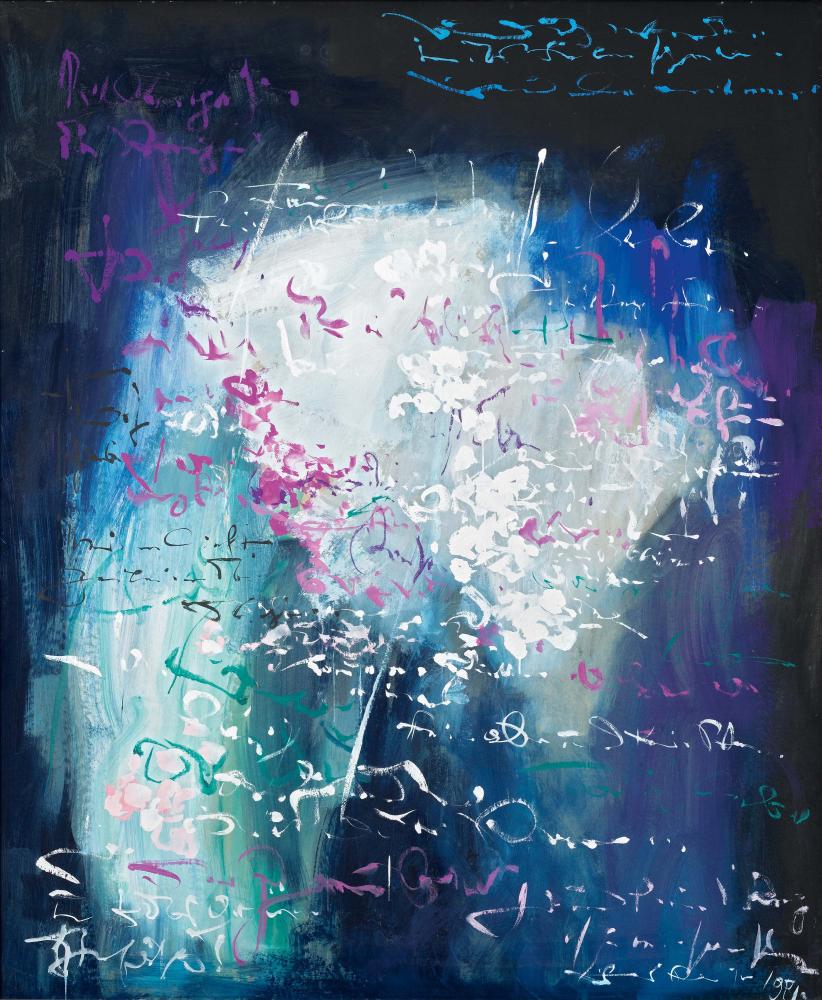
Parallel to translating his painterly language into mosaics and stained-glass windows, Kaiser abandoned all formal constraints in his painting in 1957, breaking open the rigid linear framework of his earlier Spatial Paintings through the dynamic energy of a gestural act of painting. He gave this new body of work the title Losschreibungen – a term he coined himself, for which there is no direct English equivalent. It describes a process of writing oneself free, in which the act of writing becomes a means of artistic liberation and the discovery of a new visual language. While the first works in the series are characterised by an almost explosive vehemence, those created in 1958 reveal the emergence of Kaiser’s distinctive gestural and scriptural idiom. This development culminated in the paintings of the Blue Series, where he arrived at almost monochrome fields of colour, animated only by sparse floating gestures and abstract signs. In the gestural facture of these works, Kaiser engaged with the contemporary developments of European abstract painting, particularly Art Informel. At the same time, by concentrating on the relationship between gesture, colour and pictorial space, he developed a highly individual artistic position.


With the Brandbilder (Fire Paintings), which followed the Losschreibungen series, Hans Kaiser moved beyond the gestural dissolution of form to confront the very materiality of the picture itself. Looking back on this period, he described his aim as “bringing decay itself into the pictorial space.”[4] In 1958, Kaiser proved to be a remarkable pioneer. Working independently yet contemporaneously with artists such as Alberto Burri, Yves Klein and Otto Piene, he began experimenting with fire as a painterly medium. He deliberately ignited the nitrocellulose lacquer paint on his canvases, directing the flames with his own breath and transforming the destructive force of fire into an instrument of creation. The resulting paintings bear deeply scarred and fractured surfaces, marked by fissures, ruptures and palimpsest-like layers that testify to the physical process of their making. Yet Kaiser paid a high price for this technical innovation. In 1959, after suffering life-threatening poisoning from the toxic fumes released by the burning nitrocellulose paint, he was forced to abandon the series. His recovery took several months.

![Universe (Fire Painting) (Universum [Brandbild]), 1958, Nitrocellulose lacquer, burned on burlap on wood, 226 × 148 cm, Museum Reinhard Ernst, Wiesbaden](https://hans-kaiser.de/files/styles/xlarge/public/2._universum_1958_nitrolack_gebrannt_auf_rupfen_auf_holz_226_x_148_cm_1.jpg)

Following the severe poisoning he suffered while working on his Brandbilder (Fire Paintings) in 1959, Hans Kaiser found himself compelled to embark on a new artistic beginning. Encouraged by the poet Ernst Meister, he travelled to Ibiza in 1960, where he spent three months. The journey was made possible through the support of a group of collectors, each of whom would receive a painting upon his return. Having arrived at an abstract, Informel-inspired mode of painting through the Losschreibungen and Brandbilder series, Kaiser now rediscovered landscape as his primary subject. The works created on Ibiza are characterised by a luminous, highly expressive palette and could be described as a kind of abstract impressionism, inspired by the island’s extraordinary light and landscape. In their atmospheric intensity they recall the late paintings of Claude Monet while, in a contemporary context, inviting comparison with Joan Mitchell.
In an enthusiastic review, the British art critic John Anthony Thwaites described these paintings as “exploding landscapes”.[5] Kaiser himself referred to the works created in 1960 and 1961 as his Ibizenkisches Tagebuch (Diario de Ibiza).
From 1965 onwards, he returned regularly to the island for extended periods of work, and in 1978 he established his own house and studio in Can Pep Simó. During these years he formed lasting friendships with members of Ibiza’s international artistic community, including the painters Erwin Bechtold and Emilio Vedova, the composer Stefan Wolpe, and the architect Josep Lluís Sert.


During the 1960s Hans Kaiser created the central body of his painterly oeuvre, distinguished by its characteristic gestural and scriptural idiom. Unlike many artists associated with Art Informel, for whom gesture itself became the primary focus of artistic expression, Kaiser pursued a different path. Beginning with the actual movements of handwriting – more specifically, the German Kurrent script – he explored the shifting boundaries between text, writing and image. Alongside gestural traces of colour, his paintings repeatedly incorporate blurred letters, ciphers and entire passages of writing. Oscillating between readability as text and illegibility as image, these scriptural elements invite the viewer to move constantly between reading and seeing. In this respect, Kaiser’s work forms part of the broader artistic exploration of writing that emerged during the post-war period, inviting comparison with artists such as Henri Michaux and Cy Twombly.
Throughout the 1960s Kaiser developed a succession of major cycles, each inspired by a particular landscape and its atmosphere. In 1962 he worked in a studio in East Frisia, where he created the Ostfriesisches Tagebuch (East Frisian Diary). Returning to Ibiza for a third extended stay in 1965, he completed the Ibizenkisches Tagebuch (Diario de Ibiza), begun in 1960, with a series of large-format paintings, including the key work Ibiza 1960, 1961, 1965 – and What I Have Become. In the years that followed, Ibiza remained one of the principal centres of his artistic life. In 1966, at the invitation of his friend Emilio Vedova, Kaiser travelled to Venice. His encounter with the city’s unique historical architecture gave rise to the cycle Venedig, Bildnis einer Stadt (Venice – Portrait of a City).


Alongside his paintings and applied works, works on paper occupy a central place in Kaiser’s oeuvre. From the mid-1960s onwards in particular, he produced extensive series of ink drawings and gouaches, as well as occasional collages. During the 1970s, alongside his applied work, Kaiser devoted himself almost exclusively to gouache, which became his preferred medium.
Produced mostly in Ibiza, these works are distinguished, on the one hand, by an intense Mediterranean palette and an evocation of landscape. On the other, in Kaiser’s gouaches the gestural, scriptural language of his painting moves closer once again to actual handwriting: alongside scattered signs, entire blocks of text are set within the often expansive white space of the sheets. In the “double entendre: picture-surface equals picture-space“[6] (John Anthony Thwaites), and in their interplay between visual impression and legibility, these works recall East Asian scroll paintings.


Writing and the act of writing occupy a central place in Hans Kaiser’s oeuvre, extending far beyond the predominance of the scriptural gesture in his paintings and works on paper. From the late 1950s onwards, his visual work was accompanied by extensive written reflections, lyrical notes and meditative sketches. Kaiser referred to these texts as his Einschreibungen (“Inscriptions”), a title of his own making. On the one hand, these writings function as paratexts, documenting the genesis of individual works of art. In the case of his stained-glass commissions for sacred spaces, they also reflect an intensive engagement with biblical texts, while at the same time articulating the artistic principles that guided his work. On the other hand, they constitute an independent literary counterpart to his visual oeuvre, repeatedly finding their way back into the image itself in the form of inscribed words and fragments of text. From their very inception, text and image, writing and drawing are inseparably intertwined. In Kaiser’s sketchbooks, written notes and visual sketches do not merely appear side by side; they frequently merge into hybrid forms in which thinking, writing and drawing become a single creative act.


As an artist working at the threshold between figuration and abstraction, Hans Kaiser remained committed to portraiture throughout his life. The poet Ernst Meister captured this essential aspect of his work as early as 1959:
“At no point, however, did he abandon the portrait. The human image, and always the human image. […] Portraiture: Kaiser’s true domain.”[7] Alongside his paintings, Kaiser produced countless portrait drawings in graphite and ink throughout the 1960s and 1970s. Executed with remarkable speed and economy of means, many were realised in just a few precise strokes. Here, too, drawing and writing frequently converge: the portrait is not defined by line alone, but is surrounded, accompanied and at times almost written into existence through signs and script.
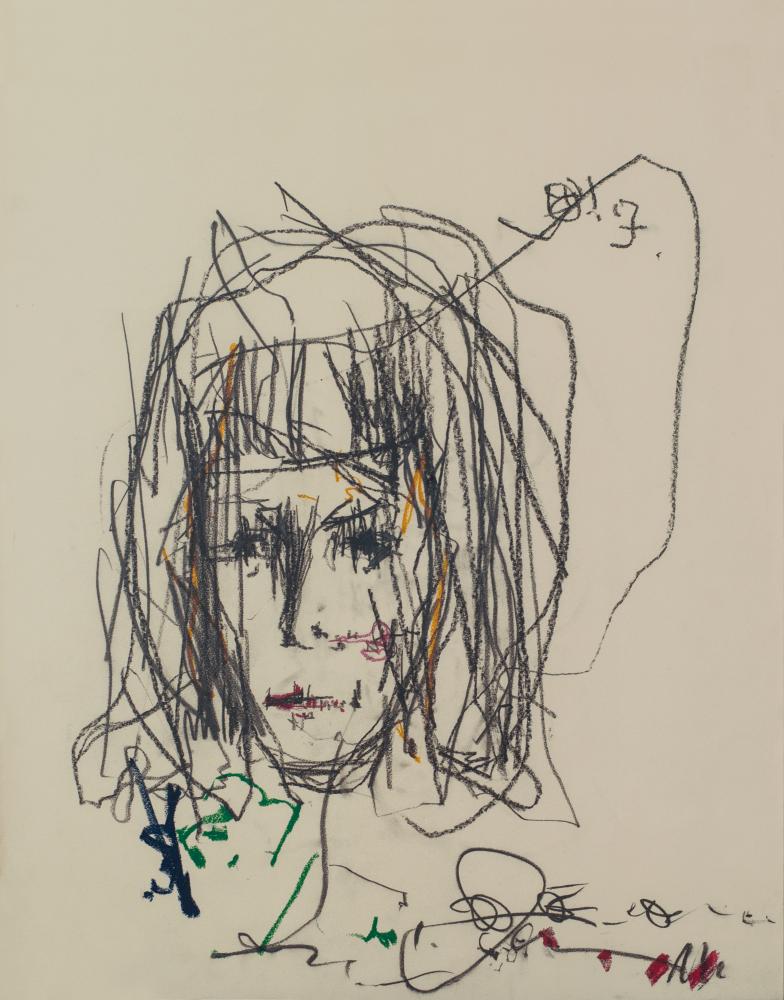
![Emilio Vedova (Time Is Passing) (Emilio Vedova [Die Zeit geht]), 1964, Graphite on cardboard, 100 × 70 cm, Museum-Wilhelm-Morgner, Soest](https://hans-kaiser.de/files/styles/xlarge/public/5._emilio_vedova_die_zeit_geht_1964_graphit_auf_karton_100_x_70_cm.jpg)

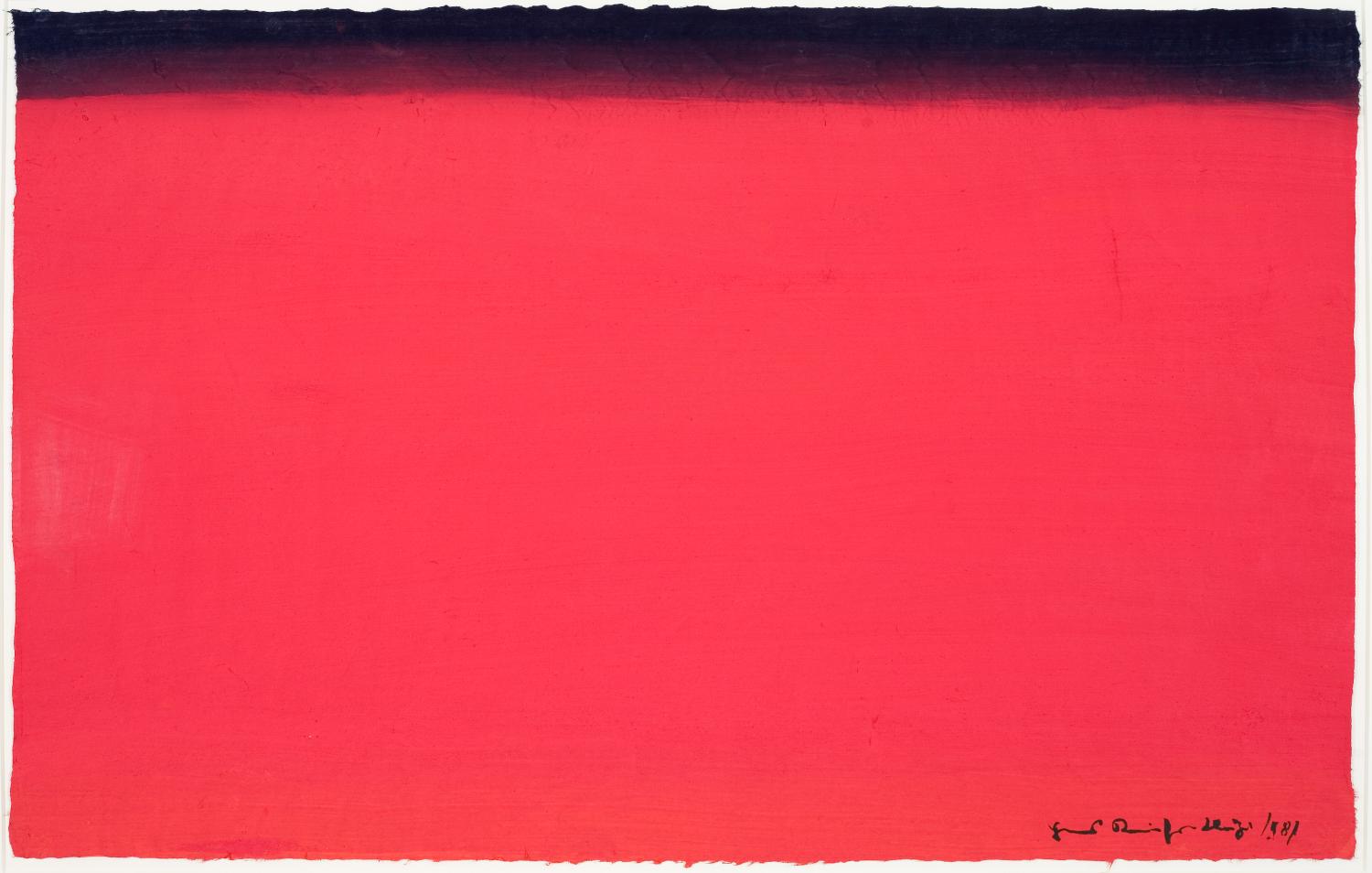
From 1978 onwards, the luminous pictorial space that had characterised Hans Kaiser’s gouaches since the 1960s gradually condensed into expansive, at times almost monochrome fields of colour. Kaiser gave this final phase of his work the title Imaginäre Räume (Imaginary Spaces). Despite the onset of the serious illness to which he would succumb in 1982, he created an extensive cycle of large-scale paintings. In these works, the recurring opening of pictorial space acquires a metaphysical dimension, reflecting the artist’s contemplation of his own mortality.

[1] Zdenek Felix: Bilder als Chiffren und Zeichen, in: Ute Eggeling, Michael Beck (ed.): Hans Kaiser (exh. cat. Galerie Utermann, Dortmund 1986). Dortmund 1986, n.p. (Translation: Johannes Kaiser-Wortmann)
[2] Hans Kaiser: Einschreibung, Ibiza, 6.4.1981, Soest City Archives, Hans Kaiser Estate, P164.55 (Translation: Johannes Kaiser-Wortmann).
[3] Josef Albers: Letter to Hans Kaiser, 21.2.1961, Soest City Archives, Hans Kaiser Estate, P 164.33 (Translation: Johannes Kaiser-Wortmann).
[4] Hans Kaiser: Einschreibung, Ibiza, 6.4.1981, Soest City Archives, Hans Kaiser Estate, P164.55 (Translation: Johannes Kaiser-Wortmann).
[5] John Anthony Thwaites: Paintings, Drawings and Gouaches, in: John Anthony Thwaites (ed.): Hans Kaiser. Köln 1979, pp. 19–30, here p. 24. The quotation originally appeared in Thwaites’ review published in Deutsche Zeitung on 4 January 1961.
[6] ibid., p. 28.
[7] Ernst Meister: Fragendes Sein, in: Hans Kaiser – Soest (exh. cat. Gustav-Lübcke-Museum, Hamm, 11 October – 1 November 1959). Hamm 1959, pp. 3–6, here p. 3 (Translation: Johannes Kaiser-Wortmann).
Text: Justus Beyerling
Translation: Johannes Kaiser-Wortmann